The occasion for this meeting arises from the Patriarch's valuable Pastoral Letter, published this past April 27th: “They returned to Jerusalem with great joy. A proposal for living the vocation of the Church in the Holy Land.”
Below is the text of the interview:
An Interview with Cardinal Pierbattista Pizzaballa, Latin Patriarch of Jerusalem
Seven days after becoming a cardinal, you found yourself facing a new phase of this endless conflict. Over the years, you have spoken a great deal, but the contents of your letter go beyond political and social analysis. Where did you start when writing it?
For some time, I felt the need to address a word to the diocese and the community, but it was always difficult to know what to say because there were so many topics. In a certain sense—alas—the war simplified things. Among the many questions that arose within me over the years, the one that emerged with the greatest force since the beginning of the conflict was: What is happening? Where are we going? Everything seemed to be plummeting into an endless drift.
At the same time, I felt the need to speak from a response of faith. Political analyses—as I have said many times—have been numerous, but these analyses do not open horizons. When I go to Gaza or to the parishes and meet the communities, I cannot simply describe what is happening; they know it better than I do because they live it firsthand. The real question is: how should we stand within this situation? It was a question that also involved me personally.
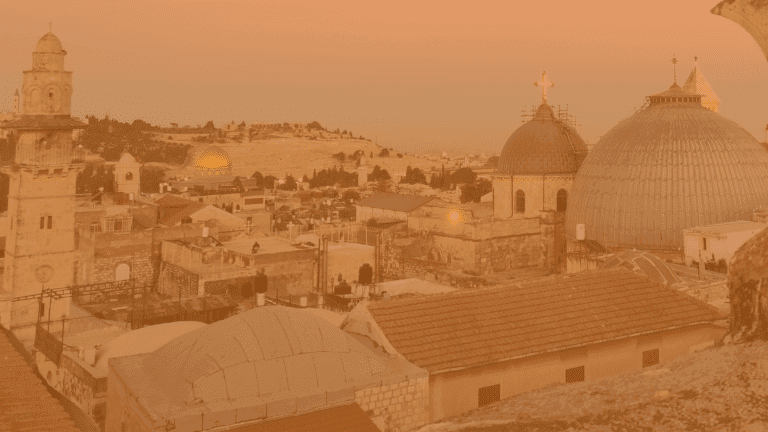
For a long time, I had in mind the image of Jerusalem as a symbol, as a heart, as an ideal reference. I wanted to find the time to pause in prayer and reflection to develop this text, which I then submitted to the review and discernment of others. However, it remains the fruit of my personal effort.
Regarding the situation, you speak of this time as a time of an "inhabited desert," but still a desert. What does it mean for the Christian community to stay in this desert? And what does it mean to meet the "other" in this human desert that the Holy Land is experiencing?
Biblically—I always start from there—when we think of the desert, we think of the Sahara, of sand where there is nothing. The biblical desert is different: it is not necessarily the place of absence; it is the place where God takes care of us. For us, being in the desert means being stripped of many trappings, of many certainties, and entrusting ourselves to God's care.
Concretely—and this is the second dimension—it means meeting the other. In the desert, the Bedouins are highly welcoming and know how to identify the places where there is water, which means where there is life. For us, this means finding water, finding life in people, in encounters, in realities. Even within the desert in which we find ourselves, these springs exist. Being liberated from so many certainties forces you, or rather helps you, to find them.
In the first part of your letter, you speak of pain, and you have emphasized several times that there is the pain of those who have been bombed, but also the pain of those who bomb. How difficult is it to stand before both without one prevailing over the other? And how can the bonds between the Holy Land and the world be preserved in such a difficult climate, full of hatred and pain?
One of the things I felt the need to say in the letter is that pain must always be respected, because it is a human experience that needs to be welcomed. However, the responsibilities are different, and it is necessary to keep these two levels distinct.
It is not about pointing fingers or accusing; it means having a free, open, and at the same time critical gaze, capable of recognizing the truth. This recognition does not necessarily have to translate into a judgment of condemnation, but it is indispensable for standing within authentic relationships.
In a situation as polarized as ours, we cannot expect everyone to understand us. What matters is:
- Being authentic, open, and available.
- Knowing how to accept criticism.
- Recognizing one's own mistakes.
- Standing within the truth.
This is also the way to distinguish which relationships are true and which are not.
There is this beautiful image of the Heavenly Jerusalem, which is never possessed once and for all, but is received and must be cherished as a gift. How does this translate into the way your Church of Jerusalem lives today? And how do you confront the temptation to transform the received gift into something to possess, even in relations with Jews and Muslims?
It is always a work to be done on oneself. The reality in which we live is very harsh, very difficult, and rarely rewarding. Therefore, every gesture of encounter, closeness, and charity is experienced as a great gift. Here, you never manage to conquer something permanently; you are always on a journey. This reality makes you very aware of this and, by contrast, also makes you savor the moments of grace that nonetheless exist.
However, the temptation to transform the gift into something to possess, which then becomes identity-based closure, is real. The idea of possession is very strong in this context; it is almost the starting point for managing relationships: if you don’t possess something, if you don't hold a position of power, you don't count, you are worthless, you have no right to speak.
We must maintain our own style, even accepting the idea of appearing like a loser. This is also the way to keep our freedom authentic: so as not to enter into dynamics that then force you to remain trapped inside them and strip away the freedom to look at God and at the other with the necessary serenity.
In the letter, you speak of the many solidarity collections you have received over these years. Alongside the generosity, however, there is also a feeling of helplessness and anxiety, almost as if people perceive that they cannot change the situation. Can the gift of self be an antidote to helplessness and cynicism?
A temptation that we all share to some extent, including you as an organization, is that of success, wanting to see the immediate result of what we do. Here, it will always be a bottomless pit because we are in a sea of pain and suffering. A gift is truly a gift if it is made with freedom and in freedom, without demanding anything in return.
Looking towards God is important precisely for this reason: it is what allows us to have freedom toward the other without expecting anything back. I am not naive; I know very well that we must also be very concrete and that the gift must reach the ground. But without the pretense of succeeding in changing everything. If you manage to bring a little light into someone's life, it is worth it.
Citing Benedict XVI, you write that the mission of the earthly Jerusalem is to become a prophecy and promise of that universal reconciliation and coexistence that God desires for the entire human family. However, the ever-open gates of the new city are incompatible with any logic of exclusion, standing in contradiction to the real Jerusalem, where the gates close every day. How does one live within this contradiction?
You just live within it. You are inside it; it is a very concrete, very present situation. First of all, you must not accept it. You must not accept this logic, which is not only political, social, or religious, but sometimes also personal, in relationships. We must remain very free and do everything possible—at a personal, community, and leadership level—to keep the doors open, or rather, to open them.
Concretely, as I wrote, it means doing everything to meet the other, to know them, to receive from them, and to keep relationships open in small ways. Not with the pretense of changing who knows what, but to keep a perspective open that would otherwise disappear.
I seem to read another important image in the letter: the new heaven of Jerusalem, where God dwells, contrasted with the sky of Babylon, a city without God. The tangible sign of this is the sacred basin where the main holy sites are concentrated. How can the beauty of this heritage, which we help to preserve, be a heaven of its own in the Holy Land?
It is a most precious heaven. The holy sites are a world unto themselves. When you cross those walls, you enter another dimension that allows you to detach yourself from the toxic dynamics of this land, to experience God, to meet Him in prayer, in liturgies, and in the strong desire for spirituality that the entire community carries with it. They are the heart of the city, of the community, and also its most beautiful part.
In the letter, you describe the small, silent presences that you call "seeds of goodness," including humanitarian organizations like ours. Is there anything that has moved you more than anything else during these two and a half years of conflict?
I won't name names, because I would risk being unfair. But yes, I have encountered beautiful and courageous realities. In Gaza, I met them even during the hardest moments of the war: people who risked their lives to stay there. Not only in Gaza, which has drawn the most attention, but everywhere: in the West Bank, in Israel. People who put themselves out there, risking loneliness and misunderstanding from their own people. There are so many of them: movements, and especially young people, very young people. This is what gives me the most hope.
There is the theme of exclusive narratives, which you have spoken about in many interviews, and in the letter, there is a clear reference to the need to re-read history in a redeemed way. How can the cultural centers present in the Holy Land carry out this task?
We cannot change history, but the way it is read can help prevent it from becoming a pretext to justify today's choices of violence. Cultural centers have a difficult task, sometimes against the current, sometimes seemingly contradictory: to provoke. They must also accept the loneliness of provoking.
We cannot expect to change a mindset, a reading, or an interpretation that is well-established and found in textbooks overnight. All this cannot be done without risking misunderstanding. But it is an important task, one that will take a long time, and yet it must be started.
Schools are another point you touch upon in the letter, defining them as a "laboratory of the future," where the possible city we dream of is built. What more can they do to foster encounters? Is there a method you would suggest?
First of all, schools must not become an island. They cannot teach history, geography, mathematics, or literature as if what happens outside their walls does not exist. Reality must enter the school, but as an opportunity for mature, serious, free, critical, and positive reflection.
Secondly, school must become the place of the possible encounter: creating occasions where these moments become formative, prepared, and accompanied, not improvised, where reflection, prayer, faith, and culture are viewed within a unified context. It means helping to achieve this synthesis and, above all, helping the student develop their own independent thinking by giving them the tools to do so.
What do you suggest to those who operate as an association, NGO, or volunteer group? What are the most important challenges for the years to come?
The first thing that comes to mind is networking. This is something that NGOs—like Churches, for that matter—sometimes struggle to do. But if we talk about encounter and dialogue, this applies to everyone. In a context where needs are so great, networking, helping each other, supporting each other, and communicating with one another is fundamental. Beyond the greater effectiveness that may result from it, it is also a meaningful style in itself.
There is a theme I would like to return to in light of the central book from which the letter starts, the Book of Revelation (the Apocalypse). From your reading of it, an extraordinary richness of the Holy Scriptures emerges. Is there a dialogue that can be started with Jews and Muslims starting precisely from this book?
On this point, you are pushing an open door with me. Interreligious dialogue, relations with Jews and Muslims, and with the other Churches in a different way, can no longer be as they were before. We need to truly meet each other. I believe it is good for each person to start from their own experience, then find respectful ways in which everyone brings their own perspective of faith.
Given my history here—I have been in Jerusalem for 36 years—bringing my experience as a Christian, my reading of Scripture, and the New Testament has never been a problem. On the contrary, it has always been something very fascinating for others.
Before arriving at the joy of the title, we must recover the feelings of the apostles: troubled, frightened, yet they return to Jerusalem with joy. From a personal standpoint: have there been moments in these years of war when you could see nothing but the desert? How do you stand before moments when everything seems dark, without falling into cynicism?
I am not a superman; I am a human being, and probably more of a sinner than many others. Yes, there have been difficult moments, even quite frequent ones. What do you do? You just stay in it. You try to talk to someone, you rely on prayer—even if in those moments prayer sometimes seems like just a few empty words muttered, or perhaps not even words.
These are moments when you just have to stay inside it. Then reality, needs, and circumstances force you to move forward, and then you overcome them and place everything in God's hands.
It is normal to experience these moments. Anyone who says they don't is lying. Morning comes. We know it. And the apostles, too, return to Jerusalem with joy
Trust, hope, and joy: words that return often at the end of your letter, along with the invitation to live them in the gift of communion. The title is "They Returned" and the letter closes with "Let us return"—let us return together. How important has communion been for you?
It is fundamental. In the second part of the letter, I begin with the Garden of Eden, where man is essentially alone. But the conclusion and the goal of everything is the city, coexistence, being together.
The Heavenly Jerusalem subsists to the extent that it receives from God, but also from others. This being together, this communion—a demanding and continuous challenge that will never end and will never be a possession—is the place where our faith and our humanity are expressed, where we encounter true relationships, built together.