




In the Middle East, the conflict continues to affect the lives of the population. We spoke about this with Giacomo Gentile, project manager for Pro Terra Sancta.
On May 28, 2026, airstrikes resumed across Lebanon, striking Beirut, Tyre, and Sidon. We wanted to discuss the situation in the country and, more broadly, how the population is living in a context torn apart by war, with Giacomo Gentile, project manager for Pro Terra Sancta, while he was on a mission in the land of the cedars.
How would you describe the situation in Lebanon?
I have been in Beirut for a few days now. At the moment, I am at the Franciscan friars' guest house in Gemmayze, just a few meters from the Port of Beirut, which suffered a catastrophic explosion in August 2020—another tragic chapter in Lebanon's history.
The first thing you notice when you arrive is the intense noise coming from the sky; I am talking about drones. There is one in particular that positions itself over the city of Beirut from 9:00 AM to 5:00 PM, producing a constant hum. This drone coordinates operations from the south all the way to the outskirts of Beirut and also monitors the movements of Hezbollah militants—it is, in fact, an Israeli military drone. This is the image I wanted to start with: a noise that accompanies every hour of the day, creating a perpetual background of anxiety and fear.
How and where are the displaced Lebanese people living?
To understand the scale of this humanitarian tragedy, we need to look at the map. In southern Lebanon, there is the famous "yellow line," an inverted L-shaped border physically guarded by the military who have advanced about 15 kilometers into the country, coming dangerously close to the Litani River. The intensification of bombings in that belt has razed entire neighborhoods to the ground and has caused, over the last two months alone, more than 1,300,000 displaced persons.
To give you an idea: we are talking about 1.3 million people moving within an area barely larger than the Marche region [of Italy], out of a total population of just 5 million. It is a staggering proportion.
This flood of people fled the south and literally flooded Beirut, later pushing all the way to the north of the country. Today, refugees are everywhere in the city: from border-line areas like the Dahieh neighborhood to the Corniche, the seaside promenade that is usually the wealthiest and most elegant area. Streets and large parking lots are now full of tents.
But the dramatic problem is that many days have passed, and living in a tent on the asphalt is no longer sustainable. Several questions arise: where are the restrooms? Where do people wash? Where do they change clothes? We are facing a massive health emergency. That is why, just in these last few weeks, we at Pro Terra Sancta have been working alongside the government and other local organizations to get people off the streets and set up what we call shelters—equipped facilities where we can restore a minimum level of hygiene, safety, and humanity to these families.
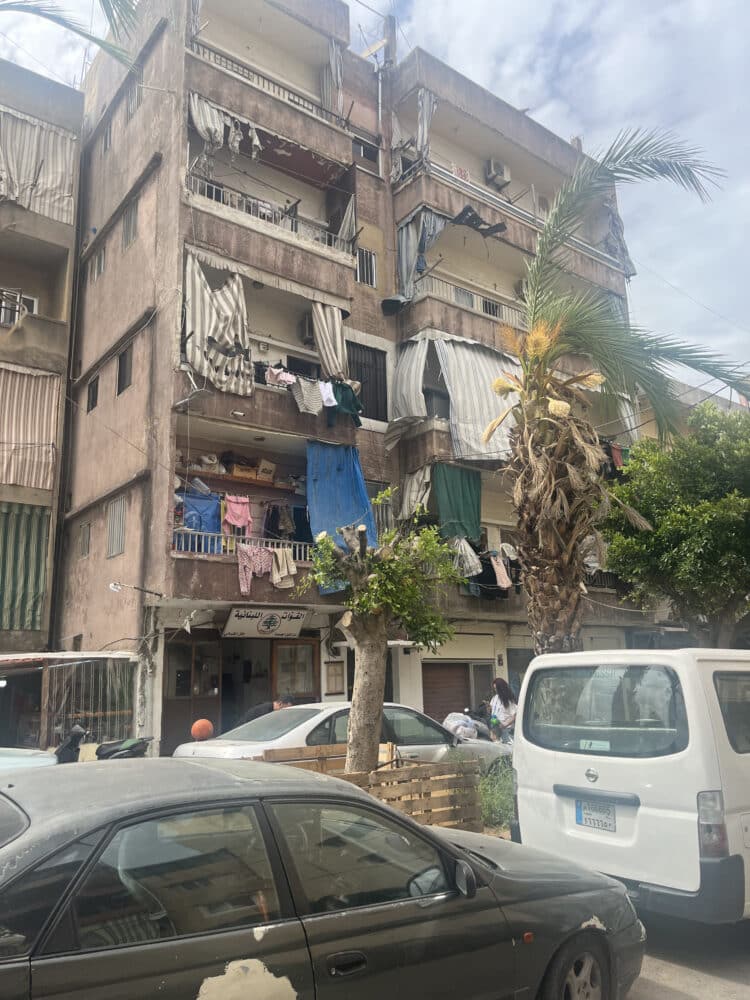
Giacomo then proceeds to show photos taken in recent days. Many depict entirely destroyed neighborhoods and houses, while others show people currently receiving aid.
What are the shelters, and what kind of help do they provide?
First of all, they include all public schools in Lebanon. They have been closed again for nearly two and a half months and are hosting thousands of displaced people living in the classrooms. Classes are suspended for everyone, and there are many children from displaced families staying in these shelters. Then there are dilapidated and abandoned public buildings that were quickly made available to take people in and get them out of tents.
There are also many convents and monasteries, especially Maronite ones, that have opened their doors to host hundreds of people. At that point, the municipalities—from Beirut to Tripoli to Zgharta—asked NGOs to collaborate and divide up these schools to assist with immediate needs through the distribution of food, clean drinking water, and soap.
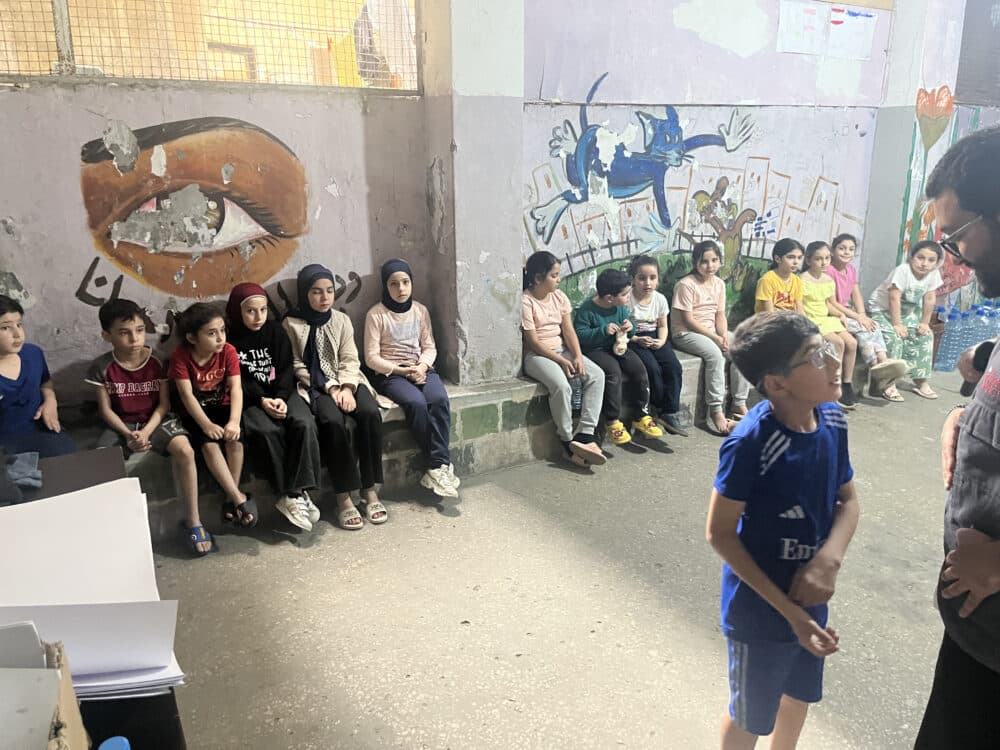
As Pro Terra Sancta, we manage six schools in Beirut and four shelters in the North, near Tripoli. Where possible, we run after-school activities and, above all, psychosocial support for the children, who are frightened and essentially spend their days with nothing to do.
What is the most tragic aspect of the ongoing crisis in Lebanon?
The most tragic aspect of the current crisis lies in the growing realization that Southern Lebanon will remain inaccessible for a long time: we are talking about one or two years, if not more. While in the autumn of 2024, facing a similar crisis, the population still hoped for an imminent ceasefire that would allow them to return to their homes, today that hope has vanished.
We are thus faced with a new question that directly challenges the government and the entire international community: What will be the fate of 1.3 million displaced people? Where will they go, and how can a country internally reorganize itself when an entire region risks remaining uninhabitable for years?
Is it possible to make a difference in a context like this?
It is possible. To provide concrete help in Lebanon today, as an NGO we have numerous active projects on the ground that address two levels of need: the material level, which is highly urgent, and the psychological level, which is perhaps the greatest challenge within this tragedy.
On one hand, there is the immediate emergency. Supporting us means backing our two medical dispensaries, one in Beirut and one in Tripoli—aid that allows us to provide medicine, cover the costs of check-ups, and ship pharmaceuticals directly from Italy. The demand is massive, both for chronic patients and for the war-wounded. It also means ensuring the operation of four soup kitchens that produce hot meals every day, food distribution, and all the educational and psychological support for displaced children in schools and shelters.
But there is a second level, which is just as important. Supporting these spaces means rebuilding the social bonds that fear is dismantling.
Today in Lebanon, mistrust is beginning to creep back in: there are Christian families who are afraid to host Shiite families, and vice versa, out of fear of becoming targets. Right here, inside this immense need, the spirit of charity becomes the only place where humanity can be rediscovered.
Helping us doesn’t just mean sending financial aid; it means allowing a lonely elderly person to come to the dispensary just to have a chat and drink a cup of tea with the doctors. It means giving an answer to that mother who told me, her voice choked with tears: "We aren't asking to live with dignity; right now, we are just asking to live. Dignity has become a luxury."
Supporting these projects means ensuring that the Pope's recent visit in November was not in vain, but continues to bear fruit. Because the profound realization is that when someone visits you and takes care of you, you find the strength to do the same for others. And that is how help is transformed into living water for everyone.





