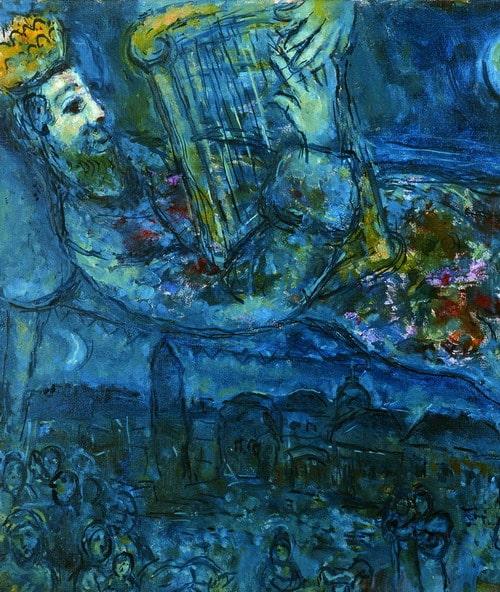


From humble youth in Bethlehem to the glory of the throne of Jerusalem, the parable of King David interweaves military exploits, sin and redemption.
The Story of King David
From youth to fame
"Boaz begot Obed, Obed begot Jesse and Jesse begot David" (Rt 4:18-21).
Born in the small town of Bethlehem, as the Book of Ruth tells us, David is a descendant of the Patriarchs and belongs to the tribe of Judah. He is the last of Jesse's sons, but he is not destined to be a simple shepherd. Indeed, the Prophet Samuel, sent by God to anoint the future king of Israel, lays his hands on the young David.
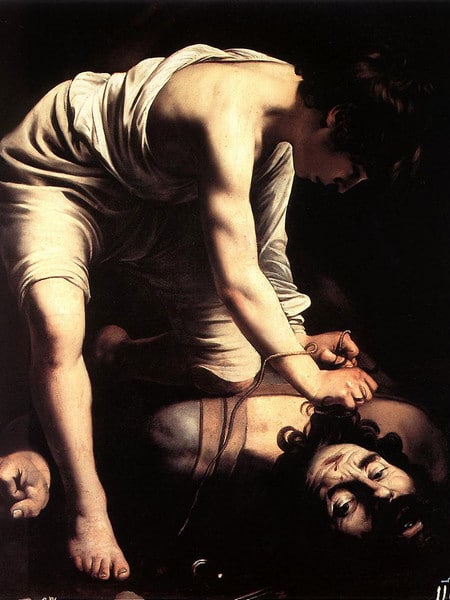
After the anointing, it is the courage and cunning with which he faces the giant Goliath, feared by all for his strength and size, that establishes the fame of the youngest of Jesse's sons.
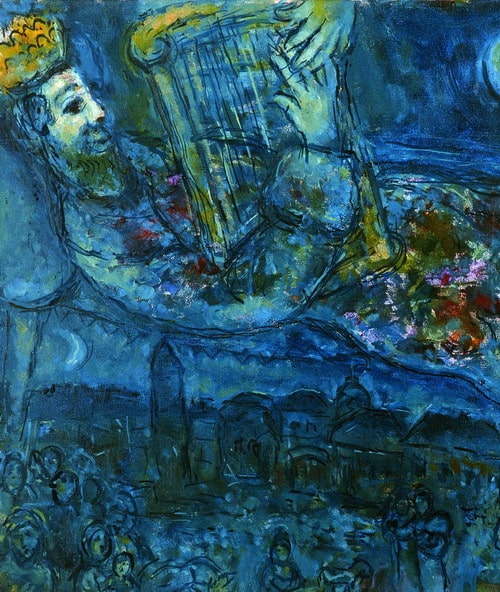
Beyond distinguishing himself for his valor in battle, David also gains fame and popularity through his music. His hands, in contact with the lyre, create heavenly melodies. Even King Saul, upon hearing him play, is so struck that he invites him to court whenever he feels sad or agitated.
"When the spirit of God was upon Saul, David would take the lyre in his hands and play: Saul would calm down and feel better and the evil spirit would withdraw from him" (1 Sam 16:23).
On these occasions, David meets Jonathan, one of Saul's sons. The two become inseparable, so much so that Jonathan will go on to protect David when his father wishes to kill him.
Envy and Persecution
Saul, however, soon notices the great fame David has acquired among the Israelites and fears he wants to usurp him. The young man, warned by Jonathan, is therefore forced to flee with a small group of loyal followers into the desert of Ein Gedi and lead a withdrawn life. On several occasions he has the opportunity to kill Saul, who hunts him with his own army, but decides to spare him because he is his king, to whom, despite the persecution, he remains faithful.
"David arose and cut off a corner of Saul's cloak without being noticed. But then, after doing this, David's heart smote him for having cut off a corner of Saul's cloak. Then he said to his men: 'The Lord forbid that I should do such a thing to my lord, the Lord's anointed, to stretch out my hand against him, for he is the Lord's anointed.' David restrained his men with stern words and did not allow them to rush upon Saul. Saul left the cave and went on his way." (Samuel, 24:6).
The Death of Saul and the Rise to the Throne
In a battle against the Philistines, Saul loses his life along with his sons, including Jonathan. David thus becomes the new king of the territory of Judah and then of Israel. The conquest of Jerusalem, freed from the Jebusites and later known as the "City of David," and the introduction of the Ark of the Covenant into the new capital mark the official beginning of the united kingdom.
Sin and Repentance
God has promised David "rest from all his enemies" (2 Samuel 7:11) and the king sees this promise fulfilled in a series of extraordinary victories against the Philistines, the Moabites, the Arameans, the Ammonites and the Amalekites.
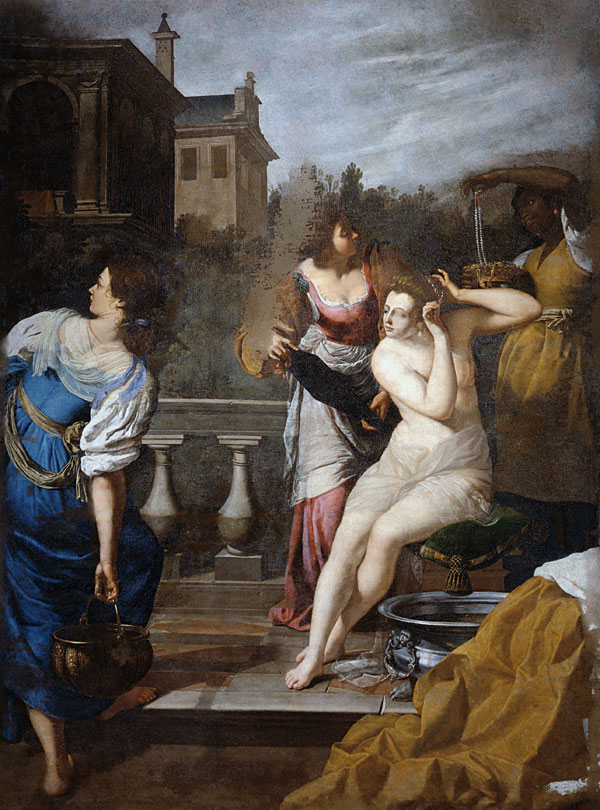
Despite God's great benevolence, David uses his own power also to the detriment of his subjects. The most famous episode in this regard is the one involving Uriah and Bathsheba. David becomes infatuated with the latter, who is however the wife of Uriah, an officer in the army. Adultery is committed at the palace, after which Uriah is sent to the front with secret orders for the commander of the army, Joab, so that he is placed on the front line in an exposed position. After Uriah's death, Bathsheba becomes David's wife. God sends the prophet Nathan, who describes to the king the future of violence that will accompany him until death because of his sin:
"Why therefore have you despised the word of the Lord, doing what is evil in his sight? You have struck down Uriah the Hittite with the sword, have taken his wife as your own wife and have killed him with the sword of the Ammonites. Now therefore the sword shall never depart from your house, because you have despised me and have taken the wife of Uriah the Hittite." (Samuel 12).
The End of David's Reign: the Advent of Solomon
Violence within the palace walls marks the final years of our king's life. In particular, one of his sons, Absalom, seeks to take his father's place and wages a true battle for power. He then dies in war, leaving David in a tremendous state of grief. Thanks to the persuasive efforts of the Prophet Nathan and Bathsheba, the now elderly David appoints Solomon as his successor, admonishing him to remain faithful to God, the only true force.
The Places Connected to the Story of Jesse's Son
In the Holy Land, there are several places associated with the story of King David, each with considerable religious and historical importance. The following are some of the most significant sites:
Valley of Elah: this valley is famous for being the place where the celebrated duel between David and Goliath took place. It is located southwest of Jerusalem and still preserves the hills and streams that formed the backdrop of the battle.
Ein Gedi: situated along the western shore of the Dead Sea, this place is known for its natural beauty, with freshwater springs, waterfalls and a wide variety of flora and fauna, found in a desert area. In the First Book of Samuel, chapter 24, David, pursued by Saul, is forced to take refuge in this oasis. Reached by Saul and his men, David has the opportunity to kill Saul who seeks him in the cave where he is hidden, but decides not to raise his sword against him.
Ir David: an archaeological site located in Jerusalem, near Mount Zion. Ir David (the City of David) is a place of great historical and religious importance, as it is believed to be the original core of the city of Jerusalem, founded by the Jebusites and then conquered by King David himself. Archaeological excavations carried out at Ir David have revealed remains of settlements dating back to the period of the First Temple, including residential structures, streets, cisterns and defensive walls.
Mount Zion: traditionally identified as the place where King David established his royal residence after conquering Jerusalem from the Jebusites. Here he built his palace and ruled the kingdom of Israel. Although there is no concrete evidence, Jewish tradition identifies Mount Zion as the burial place of King David.
The Role of David in the Monotheistic Religions
The figure of King David holds deep meaning and value for the three main monotheistic religions: Judaism, Christianity and Islam. Here is how the figure of King David is regarded in each of these traditions:
Judaism
2 Samuel 7:12-13: "When your days are fulfilled and you lie down with your fathers, I will raise up your offspring after you, who shall come from your body, and I will establish his kingdom. He shall build a house for my name, and I will establish his kingdom forever and make his throne secure."
King of Israel: King David is celebrated as the great king of Israel who unified the people and established Jerusalem as the capital. He is seen as a model of leadership and justice.
Composer of Psalms: David is traditionally considered the author of approximately half of the Psalms in the Book of Psalms. The Psalms are used in Jewish worship and are expressions of prayer and praise to God.
Divine Promises: According to Jewish tradition, God made eternal promises to David, including that the Messiah would descend from his line. This connection to the Messiah is a significant part of Jewish messianic hope.
Christianity
Acts of the Apostles 2:29-30: "Brothers, I may say to you with confidence about the patriarch David that he both died and was buried, and his tomb is with us to this day. Being therefore a prophet, and knowing that God had sworn with an oath to him that he would set one of his descendants on his throne."
Ancestor of Jesus: In the New Testament, Jesus is considered the descendant of King David through genealogy. This connection is emphasized in the Gospels, especially in the opening chapters of Matthew and Luke.
Psalms and Spirituality: Christians also use the Psalms of David as part of their spiritual practice.
Icon of Repentance: The story of David's sin and repentance, particularly his relationship with Bathsheba and the murder of Uriah, is often used as an example of repentance and reconciliation with God in Christianity.
Islam
Surah Saad (Chapter 38), Verse 26:
"O David, We have made you a vicegerent on earth; so judge between men with justice."
Prophet and King: King David is venerated as a great king and prophet. He is mentioned in the Quran and is called "Dawud" in Arabic.
Justice and Wisdom: David is considered an example of justice and wisdom in the Quran. He is described as a just and upright ruler who administered his people with fairness.
The Psalms: hymns that are always relevant
Why do the Psalms prove so charged with meaning for any reader who approaches them? As Bono, lead singer of U2, recounts, and who has drawn inspiration from the Psalms for some of his songs, the effectiveness of these verses lies in their ability to describe the human condition, full of joy and sadness, contradictions and hopes, the search for God and betrayal.
"At twelve I adored David: for me he was like a pop star, the words of the psalms were poetry and he was an idol. It must be said that, before becoming a prophet and king of Israel, David had been through quite a lot: he had gone into exile and then ended up in a cave where he came to terms with himself and with God. And it is precisely there that the soap opera gets interesting: David composes his first blues."
Bono, U2