

Palestine today faces a profound crisis: high unemployment, the progressive marginalization of local communities, and an invaluable cultural heritage at risk of deteriorating under the weight of conflict and a chronic lack of resources. In such a complex scenario, culture is not a luxury, but a concrete starting point for building the future. It is precisely from this premise that the Taybeh Open Day was born—an event that is not an isolated celebration, but the fruit and public manifesto of Judoor (meaning "roots" in Arabic), a broad cooperation project launched in October 2024.
Funded by the Italian Agency for Development Cooperation (AICS) and implemented in collaboration with the Mosaic Center Jericho, Grassroots Al-Quds, Vento di Terra, Viaggi e Miraggi, and CRIC (Regional Intervention Center for Cooperation), the project is active in the key areas of Taybeh, Jericho, Bethlehem, and East Jerusalem. Judoor has an ambitious goal: to promote the socio-economic development of the most vulnerable Palestinian communities through the enhancement of cultural heritage and sustainable tourism. The Open Day concretely demonstrated how historical memory can be transformed into economic opportunity and collective identity.
Perched on a strategic hill overlooking the Jordan Valley and the Dead Sea, the village of Taybeh (the ancient biblical Ephraim) represents one of the few villages in the West Bank whose population has remained entirely Christian.
The Taybeh event faithfully reflected the three complementary fronts on which the Judoor project is developed to create skills, jobs, and deep-rooted community connection:
1. Conservation and Enhancement of Historical Sites
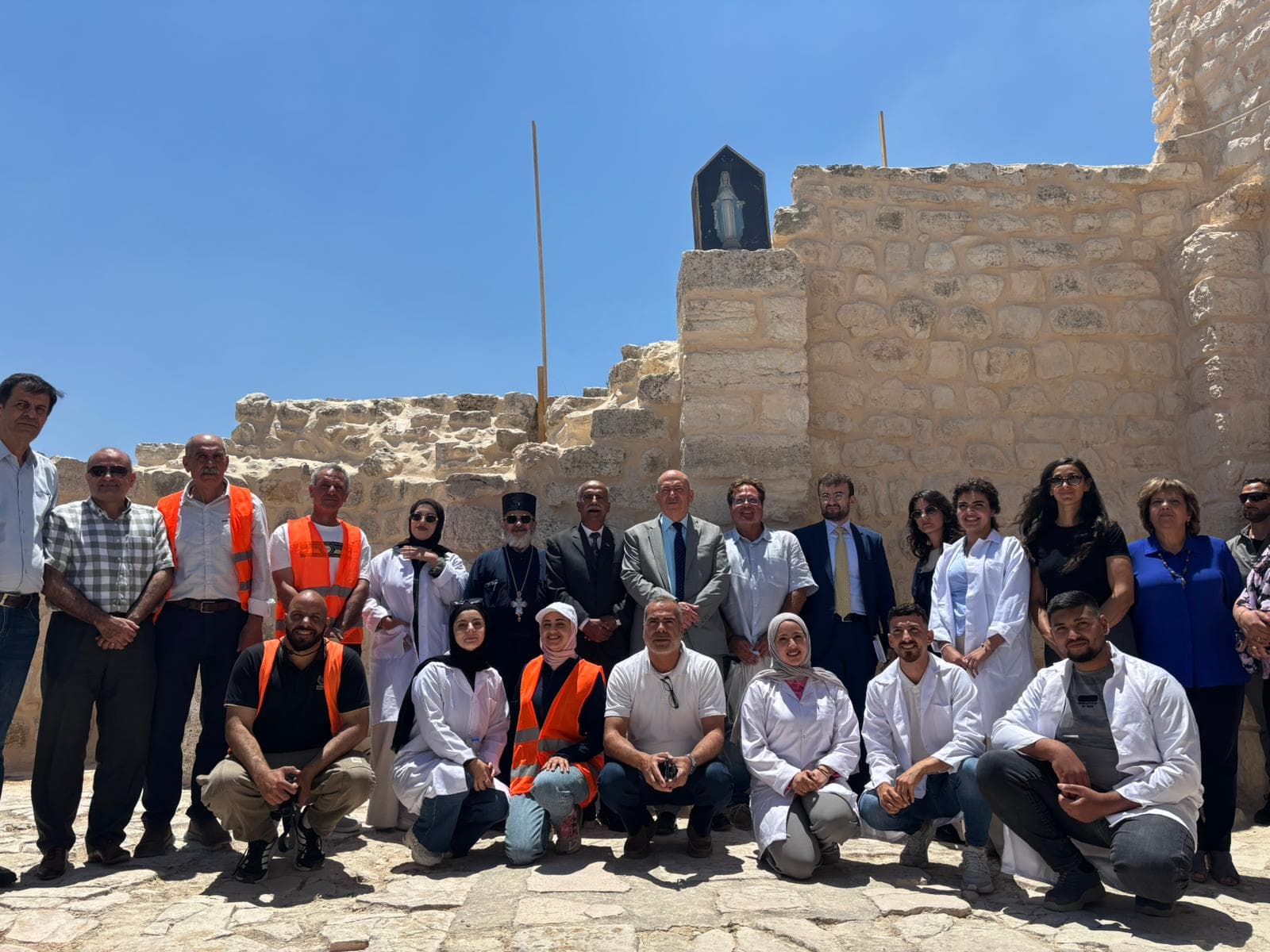
The day opened with the presentation of the complex restoration works on the local church. The expert, Najati, supported by Osama, illustrated the technical site conservation operations in detail. Najati explained how this worksite represents the crowning achievement of a long preservation journey that began over twenty years ago, historically linking back to the French excavations of 2000, the legacy of Father Michele Piccirillo, and the subsequent efforts of Carla.
As Diletta, representative of Pro Terra Sancta, recalled:
"We wanted to show the work that goes on behind the scenes, to explain the importance of conservation for the community. This Open Day served to send a profound message that goes far beyond simple technical restoration."
2. Training and Micro-Entrepreneurial Development for Youth and Women
Judoor places the economic inclusion of the most vulnerable groups at its core. During the event, at the Municipality's request, the square filled with stalls run by residents to display and sell local products. Standing out was the presence of a local women's association offering za'atar, olive oil, and sun-dried tomatoes in oil, alongside a woman showcasing traditional handmade embroidery and a stand from the village's historic family-run brewery and winery. This is a concrete way to transform traditions into micro-entrepreneurship and sustainability for families.
3. Responsible Tourism and Participatory Networks
The Open Day demonstrated the importance of networking to break isolation. Alongside Pro Terra Sancta and the local institutions, youth from CIK, Vento di Terra, and Grassroots were present—project partners collaborating on building sustainable itineraries and tourism products. The socializing, music, and strong sense of community during the day offered residents a moment of togetherness and the prospect of a participatory tourism model capable of attracting future visitors.
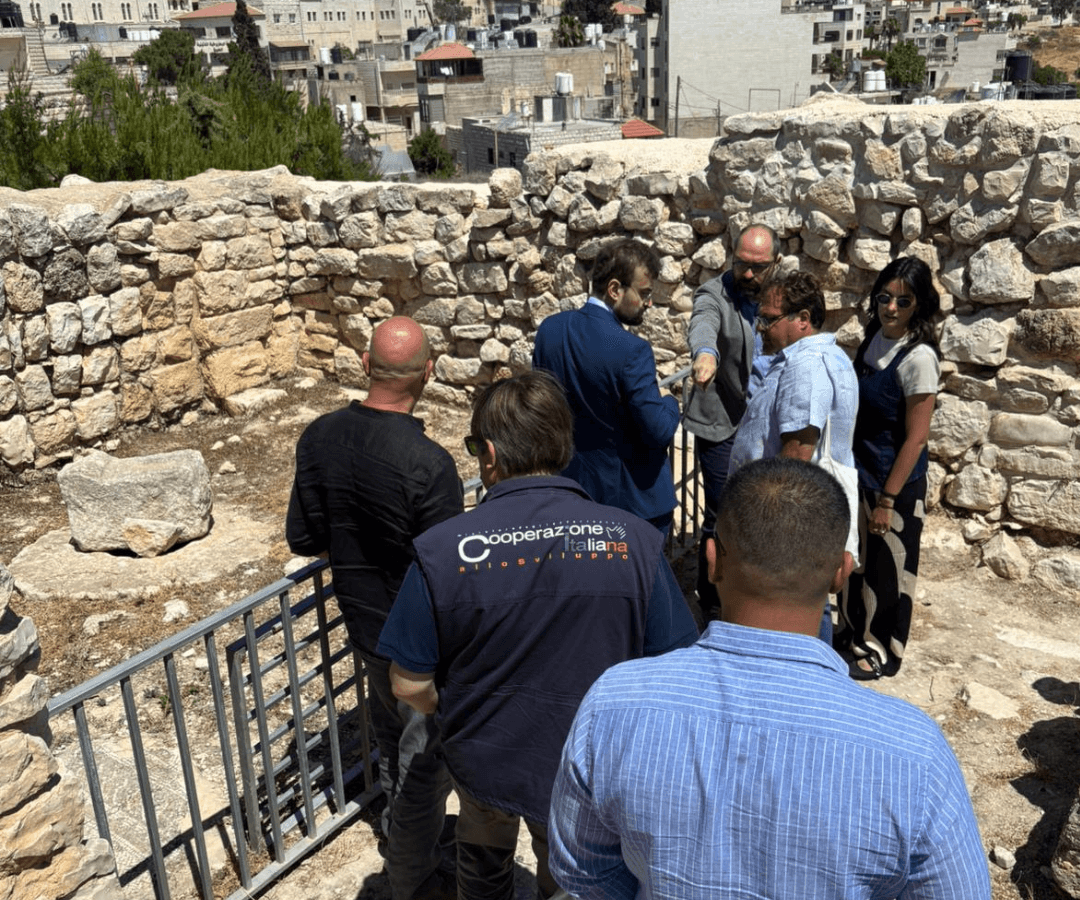
Some of the authorities present visit the site
An Institutional Presence Against Isolation
The strategic relevance of Judoor was highlighted by the participation of top authorities. The day opened with greetings from the Mayor of Taybeh, Suleiman Khourieh, followed by speeches from the Deputy Consul of Italy Damiano La Verde and the Director of AICS, Mirko Tricoli, whose presence sealed Italy's strong commitment to the funding and success of the project. Mr. Hani Al-Hayek, Minister of Tourism and Antiquities, also took the floor to reiterate that protecting these sites is the only viable path to guaranteeing an economic and tourism future for the region.
An Alarm Call: An Economy Choked by Blockades
Unfortunately, the enthusiasm of the Open Day clashes with a harsh daily reality. Mayor Khourieh issued a heartfelt alarm: about 80% of the village's land, located in the eastern area, is now completely inaccessible to farmers due to a new settler outpost in the mountains, blocking the olive harvest for nearly three consecutive years. This is a financial and spiritual catastrophe. As Abuna Jack, parish priest of the Melkite Greek Catholic community, bitterly recalls:
"When there is no oil, even the elements for the sacraments are missing."
The famous local brewery must also contend with suffocating logistical restrictions: severe military blockades make it nearly impossible to export its product to international markets.
With unemployment hovering around 60% due to the military regime of "Area C"—which has revoked work permits to Jerusalem and Israel—Taybeh is experiencing a worrying demographic drain. Dozens of families and young people have chosen permanent emigration to the United States, Chile, Guatemala, or Spain. “To stay, we must endure and be witnesses,” urges Abuna Jack, who, together with Father Bashar of the Latin Church and the Greek Orthodox Church, leads an extraordinary ecumenical coordination to provide material assistance and temporary employment to residents.
Ancient Stones and "Living Stones"
Historically, Taybeh is home to the Byzantine site of Al-Khader (5th–6th century AD), where the Gospel of John recounts that Jesus withdrew with his disciples after the resurrection of Lazarus. The recovery of these ruins forms the backbone of local identity, but the appeal issued to international organizations demands urgent interventions: physical protection from acts of vandalism, the unblocking of agricultural lands, the dismantling of checkpoints paralyzing movement, and the restoration of regular employment.
The final message from Mayor Suleiman Khourieh perfectly encapsulates the philosophy uniting Pro Terra Sancta and the Judoor project:
"What is the meaning of holy places, what is the meaning of ancient stones if we let the living stones die—namely, the Christians who have inhabited and guarded this land from the very beginning?"
Enhancing Taybeh's history does not mean looking to the past, but rather planting the "roots" upon which the local community can, and must, build its tomorrow.