

Here is the English translation of the article, maintaining its evocative, narrative style and journalistic clarity:
Two Schools and One Future
The Franciscans opened the school in Knayeh, Syria, in 1958. In 1972, just fourteen years later, it was occupied. In recent times, for ten years, it served as an (unauthorized) shelter for jihadists. On Sunday, September 20, after more than fifty years, it became a school once again. Reopening alongside it was the school in Yaqubiya, just one kilometer away.
Yaqubiya and Knayeh are two Christian villages in the Orontes Valley, located in the province of Idlib, a few kilometers from the Turkish border. Since 2015, the area had been controlled by jihadist militias—first Jabhat al-Nusra, then Hayat Tahrir al-Sham. For the Christians who remained, this meant living under rules imposed by others: crosses removed, properties confiscated, and worship restricted strictly to what could be done inside church walls. Many left. The Franciscans of the Custody of the Holy Land stayed.
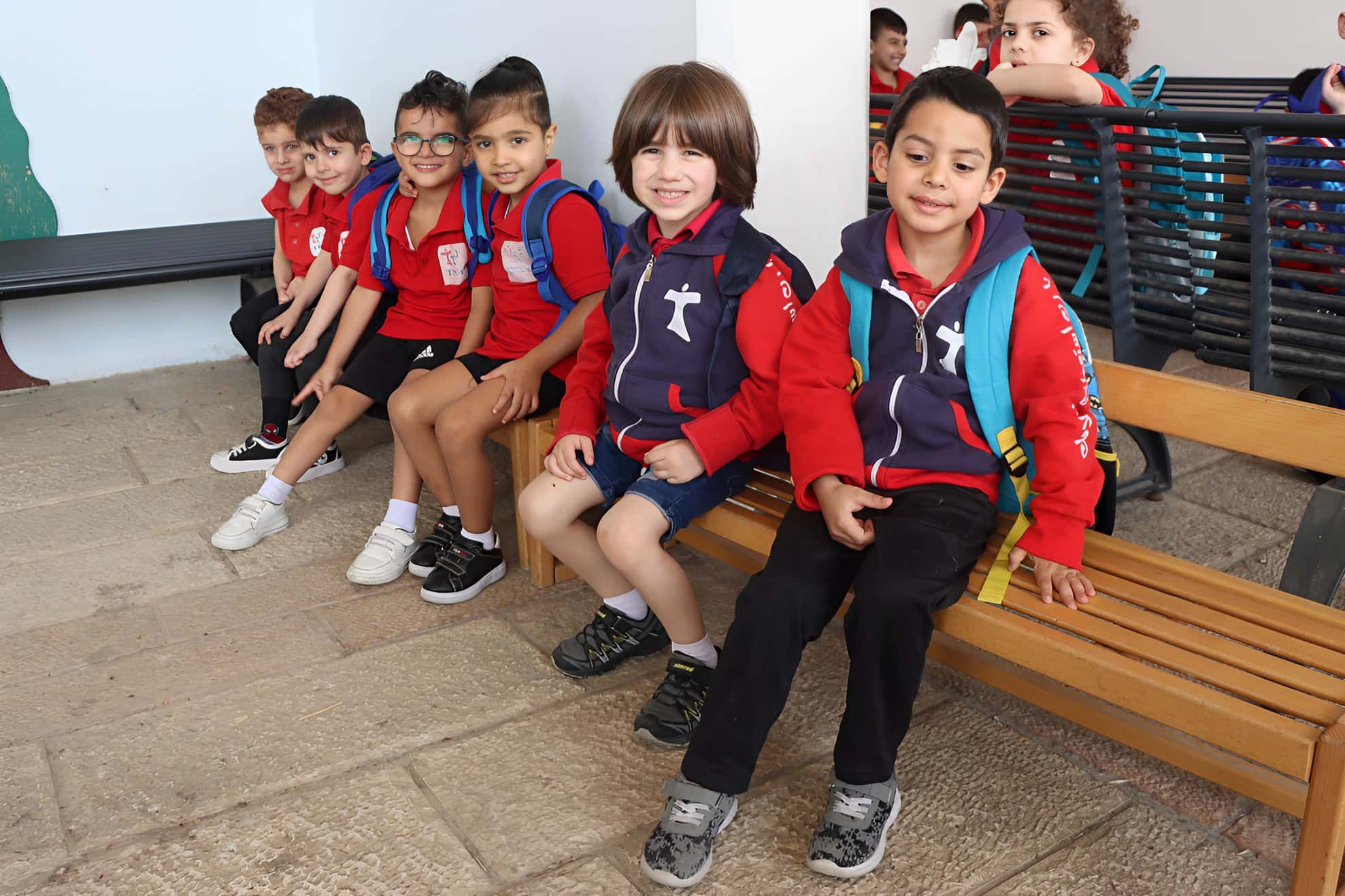
During the siege, when movement was impossible, parish priests Fr. Khoukaz Masroub and Fr. Luai Bisharat reclaimed a few rooms and resumed teaching twenty children. Following the fall of Assad, the last displaced persons departed, and restoration work began at full speed, powered by a coalition of organizations coming together. Today, the buildings are 80% restored. Children aged three to ten study in Yaqubiya, while youth aged ten to seventeen attend classes in Knayeh.
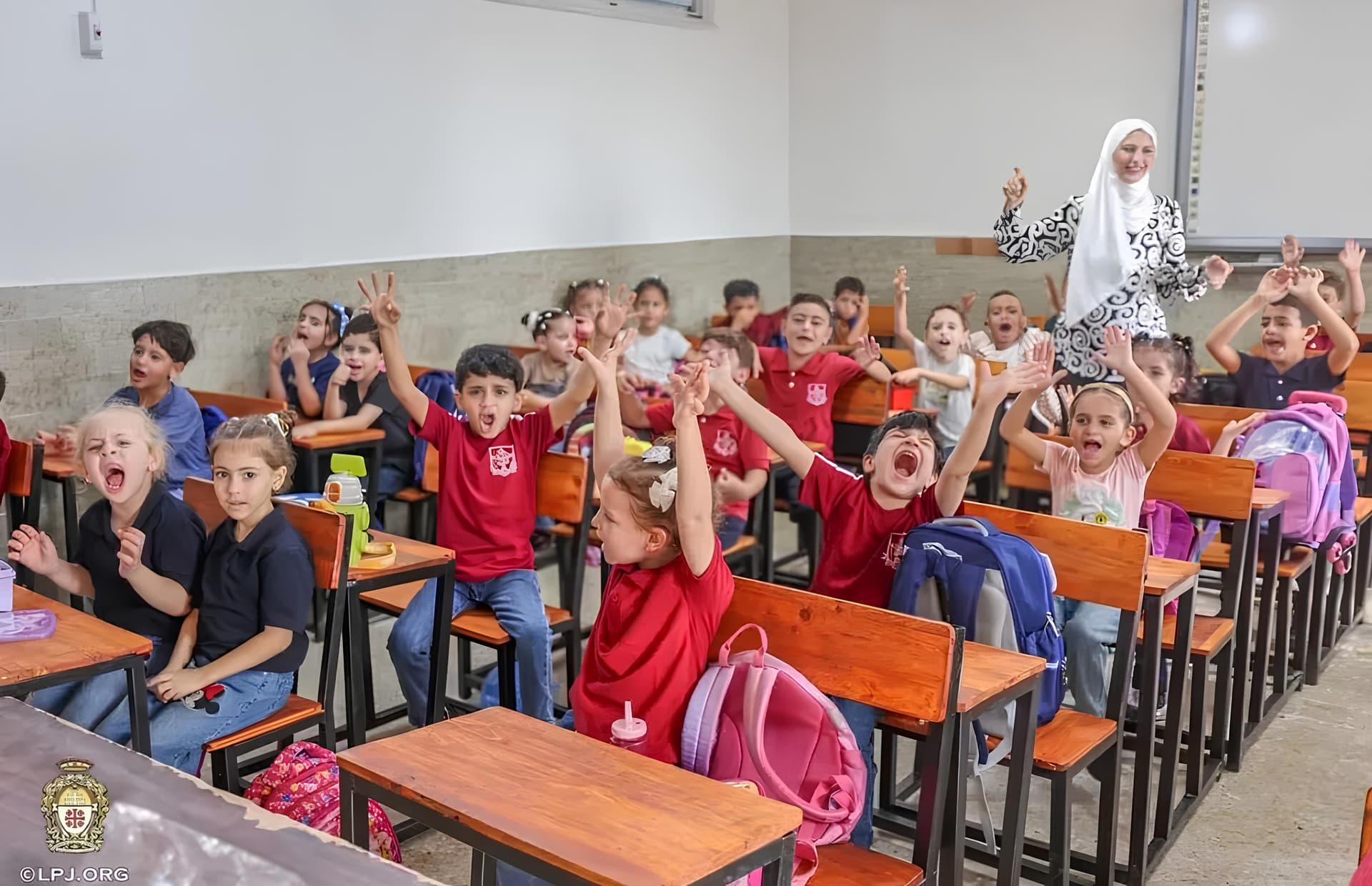
Around the same time in Gaza, the school of the Latin Patriarchate of Jerusalem reopened its doors. Enrolled: 1,005 children and teenagers, ranging from kindergarten to the final year of high school. Returning to work: 77 teachers. They emerged from nearly three years of interrupted schooling. During the war, Holy Family Parish continued to hold classes for the displaced children staying on its premises. In the spring, as some families returned to their homes, space opened up to welcome more students. Today, it stands as the only active Christian educational institution in the Strip. Desks, notebooks, and basic supplies remain in short supply.
These are two different stories. Idlib endured ten years of jihadist rule; Gaza suffered the most destructive war in its history. Yet those who stayed behind in both places reached the same conclusion: right after bread comes school.
Those who ruled the Orontes Valley in recent years permitted only a single identity. A school open to everyone, by contrast, is the most tangible answer to any exclusionary narrative. Upon returning to Syria, Fr. Masroub met the local mosque’s sheikh. The sheikh shared that he had studied at the Holy Land school before its closure—and that his English teacher had been the friar’s own father. Today, the school serves 80 students. Once works are completed, it will accommodate nearly 300, including children from Muslim families. In Gaza, the Patriarchate school already welcomes students from across the entire local community, not just Christians.
Bishop Hanna Jallouf, Apostolic Vicar of Aleppo, spent the war years in that very valley as the parish priest of Knayeh. He puts it plainly: "In so many years of war, young people learned only the trade of war." Now, he adds, "we must teach them the trade of peace and coexistence." That is what a school is for.
Syria emerges from fifteen years of war with a shattered economy. According to the United Nations, roughly nine out of ten Syrians live below the poverty line. In Gaza, the economy simply no longer exists. Under such conditions, school is often the first thing a family gives up: a working child brings home an income and, above all, costs nothing.
Every child who leaves school at twelve is a future technician, nurse, or teacher lost. The damage is not immediately visible, but it accumulates over time. In Gaza, a child who entered first grade in 2023 returns to the classroom today having never actually attended. For this reason, the school is launching psychological support activities for both students and teachers. In Knayeh and Yaqubiya, the 25 teachers are young local graduates who returned to Syria after the war. A school serves to foster local talent and bring back those who had left.
In humanitarian work, there is a tendency to separate emergency aid from development: first food and shelter, then—when possible—everything else. In Knayeh and Gaza, that transition is visible within the walls themselves. Spaces that once sheltered the displaced are returning to what they were meant to be: classrooms.
A school generates economic activity even before it opens. The construction site in Knayeh and Yaqubiya provided jobs for nearly one hundred people—electricians, carpenters, craftsmen, and laborers—providing income for a hundred families in a country where unemployment is another severe emergency. Then there are the salaries of the teachers: 25 in Syria, 77 in Gaza. And there is the effect that is hardest to measure. Those considering a return do not look first at the country's political stability; they ask if there is a home, a job, and a school for their children—the essentials of life. Today, two hundred families live across Knayeh, Yaqubiya, and nearby villages: double the number present during the war.
At the inauguration in Syria, Fr. Francesco Ielpo, Custos of the Holy Land, expressed his gratitude to the friars who supervised the project. He noted that the best expression of the Franciscan presence is "to remain beside the people, to share their burdens, and to rebuild hope together."
As of this week in Yaqubiya, Knayeh, and Gaza, there are once again classrooms, attendance books, and homework to grade. And children, returning to learn—and to look at one another, perhaps with a sense of wonder. These are the ordinary things upon which the future of both lands depends. As Cardinal Pierbattista Pizzaballa repeatedly emphasized during his visits to Gaza: "Without education for children, how can there be hope?"