



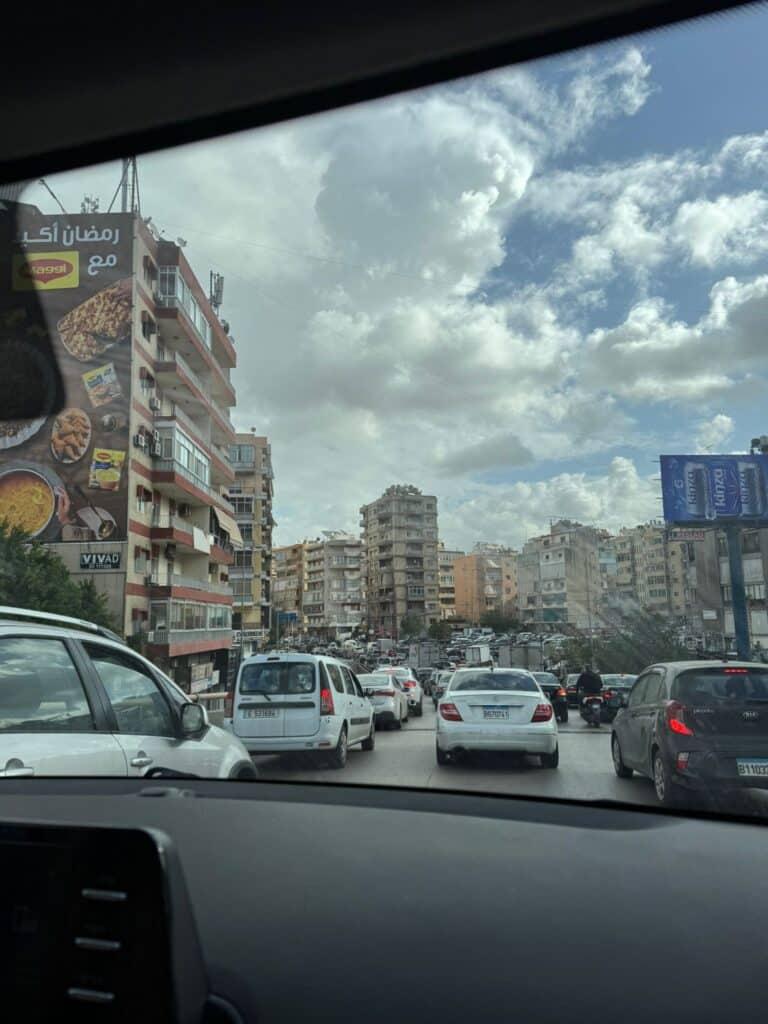


In Lebanon, I realized that one’s presence is already an answer: the deepest sense of a mission is, quite simply, to be there.
Martina Murachelli works within our project office and returned to Italy a few days ago, just before Lebanese airspace was closed to civilian flights. Her return coincides with a phase of extreme crisis: starting from March 1, 2026, in just 48 hours, over 3,800 Israeli bombs hit Southern Lebanon.
The offensive took an even more dramatic turn with the launch of a ground invasion by Israeli forces, triggered in response to Hezbollah missile launches following the killing of the Iranian leader Khamenei. The toll is tragic: at least 50 dead, hundreds wounded, and over 35,000 displaced people fleeing destroyed villages.
In this scenario of open war, which worsens an economic and social situation already in collapse since 2019, Martina’s testimony helps us understand what it means to operate in Lebanon today and the real value of humanitarian assistance on the ground.

This was your first mission in Lebanon and, in general, your first field experience. In light of recent developments in the Middle East—such as the killing of the Supreme Leader and the intensification of Israeli bombings—what kind of country did you find upon your arrival?
Lebanon was a huge discovery for me: a beautiful land, characterized by very diverse landscapes and cultures, but one that unfortunately continues to deal with severe internal and regional instability.
Upon arrival, I found a country wounded by a crisis that has dragged on for far too long. The consequences of the 2019 banking freeze, worsened by the Beirut port explosion the following year, are still visible in the daily lives of the population.
I was deeply struck by seeing so many children forced to beg on the streets: a condition that initially mainly concerned displaced Syrian minors, but today involves an increasing number of Lebanese families. It is proof of how the crisis has now overwhelmed the entire society across the board.
In fact, during my month-long stay, I perceived a widespread sense of resignation. It almost seems as if the population has become "accustomed" to a perennial emergency: people are absorbed by pure daily survival, leaving little room for protest or hope for radical change.
The difficulties are evident: rising poverty, a shrinking middle class, collapsing schools and public healthcare, and a general distrust in institutions.
Life is a continuous challenge: securing electricity with a generator, paying for basic health insurance, or affording sky-high school fees are insurmountable obstacles in the face of derisory wages and out-of-control costs.
In light of recent developments, the situation is more critical than ever. Since the day of my return, I have been following the news with great anguish. Faced with such violence, there are no words to describe the sadness; seeing thousands of civilians displaced and entire infrastructures razed to the ground leaves you with deep anger and a great sense of helplessness.
My thoughts go first and foremost to the population and to our colleagues who do not stop working for a single moment. By carrying out our activities on the ground, they try to offer small moments of relief in such a dramatic context.

What was the main reason for your mission in Lebanon and which projects did you work on?
The main objective of my mission was to support Silvia Zucconelli, who has served as Project Manager at the Pro Terra Sancta office in Beirut for about a year. Specifically, I assisted her in drafting a project born in response to an emergency call from the Italian Agency for Development Cooperation (AICS) for Lebanon.
The proposal aims to improve workforce employability and stimulate local economic growth by strengthening market systems and promoting dignified, safe, and inclusive income opportunities. Working in close collaboration with two other Italian NGOs rooted in the area, CTM and Armadilla, we built a comprehensive proposal, attentive to the concrete needs of the population and consistent with the difficult current context.
We chose to focus on the agricultural and agri-food sector: in a country hit by such a deep economic crisis, we are convinced that strengthening local supply chains and supporting small producers and vulnerable workers is the key to promoting resilience and sustainability in the medium-to-long term.
At the same time, I contributed to the drafting of a further project related to our psychosocial support (PSS) activities, aimed at children, teenagers, and adults in various centers in Beirut.
I also handled the healthcare portion, including medical visits and drug distribution in the dispensaries of Beirut and Tripoli, as well as supporting the entrepreneurship program for young people wishing to start or consolidate their own businesses.
In light of recent events, our interventions take on an even deeper value: they are the necessary bridge connecting humanitarian aid to a true long-term development perspective. In fact, while we respond to immediate needs with healthcare, psychosocial support, and food distribution, we also promote true paths to autonomy by strengthening the capacities of individuals and the community.
In a context of such prolonged crisis, this approach represents the only way to trigger stabilization processes that are truly lasting.
What value does humanitarian assistance hold today in a context marked by continuous instability like that of Lebanon?
It is essential. When I learned that the flights back to Italy scheduled after mine had been canceled, I realized how lucky I was to be able to call "home" a place that is safe and far from the noise of war. This awareness made me reflect deeply on a privilege we often take for granted.
I am convinced that, precisely because we find ourselves in a position of greater stability and security, we have an extra responsibility toward those who did not have the same fate.
In a context like Lebanon, where institutions struggle to guarantee essential services, humanitarian assistance often represents the only concrete safety net: it is the only hand we can extend to offer not only immediate material support but also a sign of closeness, solidarity, and commitment to a more dignified future.
What was the meeting or episode that summarizes for you the deepest meaning of this month spent in Lebanon?
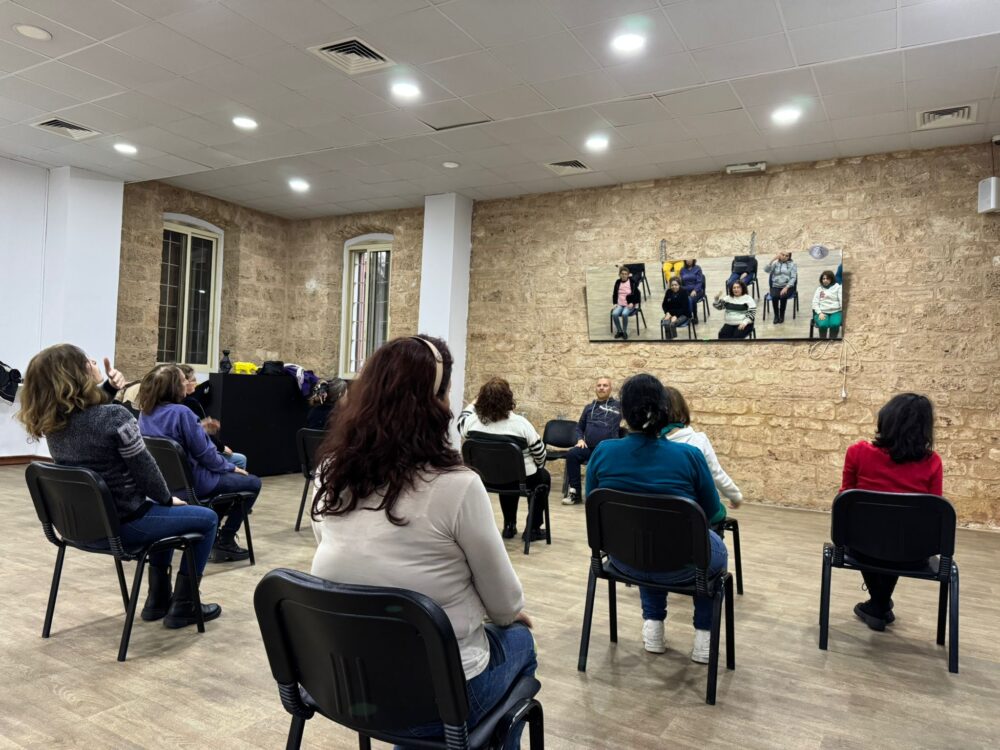
There isn't a single episode: every day and every encounter left a deep mark. However, if I had to choose a symbolic moment, I would think of my participation in a food distribution in Beirut and the psychosocial activities dedicated to women.
The beneficiaries arrive with a smile, and it is clear that they experience these spaces not just as moments of assistance, but as true places of listening. In particular, the PSS activities with women showed me how much psychosocial support can make a difference in a crisis context.
During the various sessions—from bodywork and movement to theater activities and group meetings with the psychologist—common elements always emerged: the need to be seen, heard, and taken into consideration. Each of them sought a space where they could tell their story and show themselves to others in an environment they considered safe.
I was also very struck by the way they sought approval and looks of encouragement, not only from the operators leading the activities but also from me, as I was present as a silent observer. In that moment, I understood that, sometimes, one’s presence is already an answer: I realized how fundamental it is, simply, to be there.
The deepest sense of a mission, in fact, lies not only in the written projects or expected results, but in the relationships built and the spaces of shared humanity.





